
There’s a café towards the beach, and one to the west.
Depending where I am, and who I’m with, We’ll choose one or the other.
The one to the west is nowhere near as good as the one by the beach. It’s consistently average (service and coffee)
The one by the beach is good. Consistently.
The thing they have in common is that both of them keep their promise. One of being excellent, and one of being average.
As business owners, there’s an important graph we can draw.
On the horizontal axis is any attribute we want. Left to right it could be poor service > great service. It could be low sense of belonging > high sense of belonging. It’s the promise we make about what we do.
On the vertical axis is another attribute. At the bottom, “Don’t keep your promise,” and at the top “Keep your promise.”
This makes a chart.
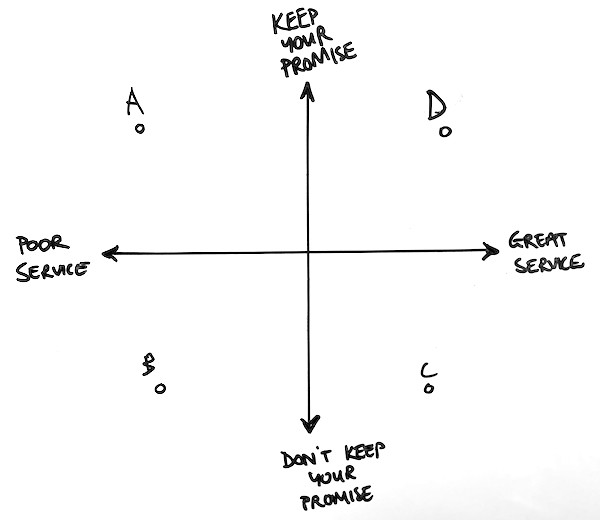
A) Top left you can have poor service and keep your promise. This is worth little, but you can still survive because we can trust you and you might be convenient.
B) Bottom left you can have poor service and not keep your promise. Death zone.
C) Bottom right, you can have great service but not keep your promise. Thin ice. You’ll lose many, because trust plummets and we can’t refer something we don’t trust.
D) Great service, and you keep your promise. When a mistake pops up, there’s an effort to make the outcome even better than the original, so there’s a story to tell.
Just like “level of service,” “level of research,” or “level of care,” the extent which you “keep your promise” is a choice, and it tells a different story.
And where you sit on this vertical axis is just as important as where you sit on any horizontal axis, because this drives trust.
A great result, great service, or great idea is important, but if you don’t keep that promise (to others and to yourself) over time, then we’ll probably look for someone that does.
